

 Written by Alecia Ridout,
Sept 25, 2026
Written by Alecia Ridout,
Sept 25, 2026
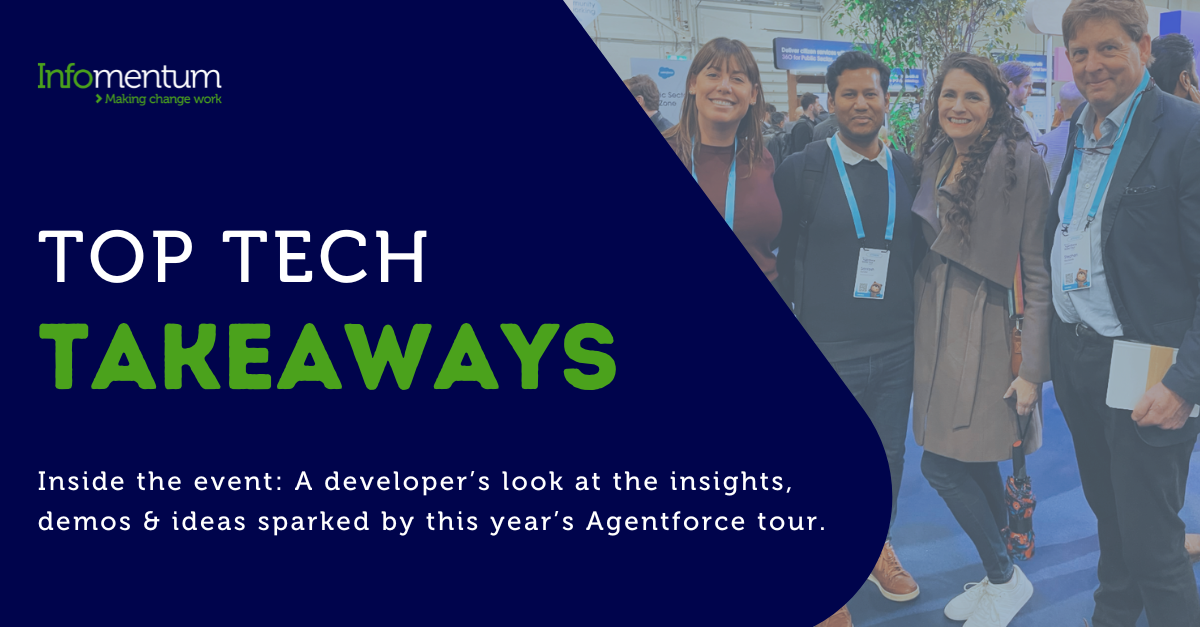
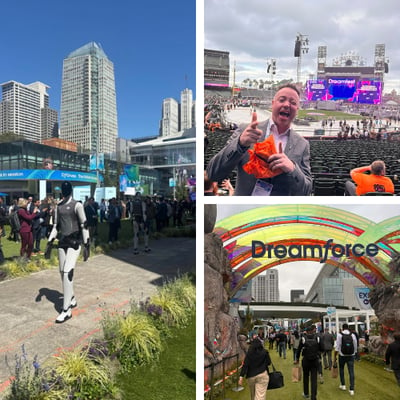
I’ve wanted to go to Dreamforce for a decade. Salesforce Marketing wasn’t exaggerating - it was unforgetable (as was the Cabernet Sauvignon). Without sounding as middle aged as I am, I literally felt like I was living in the future.
Driverless cars dropping us off at dinners. Robots walking through the conference. An agentic business development representative more efficient and competent than I’ve seen in more than a decade of sales experience. Then there’s Dreamforce itself. Tens of thousands of people across the campground. 1,600 sessions to choose from. Gwen Stefani opening the keynote. And then Dreamfest.
So yes, there was a lot going on and I’ve finally gotten round to my wrap up!
AI agents are moving from answering to doing
The shift was hard to miss. We’ve spent plenty of time talking about AI that can find information, answer questions and help someone complete a task. At Dreamforce, agents were increasingly being shown carrying out the work themselves.
Salesforce unveiled a growing line-up of out-of-the-box Agentforce agents, but the demos told the more interesting story. At Siemens, Piper turned a website conversation into a qualified opportunity and booked a meeting, while Marshall learned a complex supplier onboarding process before carrying it out in SAP. Adecco brought voice into the mix, with an agent checking an applicant’s certification and updating their application during the call.These weren’t agents sitting on the sidelines suggesting the next step. They were moving real processes forward. So, what work are businesses actually prepared to hand over to an AI agent?
Turns out, AI is only part of the story
A brilliant AI agent without the right business context can only get you so far. It needs to understand your customers, your data, your rules and the systems it can act across.
That was a big theme from the keynote.
-
Informatica gets data into shape.
-
Data 360 brings it into context.
-
Tableau gives it business meaning.
-
And MuleSoft Agent Fabric helps connect and govern agents as the ecosystem grows.
The smartest model isn't necessarily the biggest advantage. Giving it the right context to make good decisions and take useful action could be.
We're starting to rethinking what 'using Salesforce' looks like
For years, using business software has meant opening an application, finding the right screen and working through a series of fields and steps. One of the week's biggest announcements offered a very different picture.
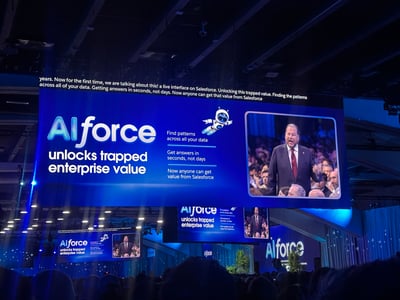
AIforce is Salesforce's new live interface layer. During the keynote, Patrick Stokes built a command centre through a conversation with Claude, bringing live pipeline, service and marketing information together and triggering tasks without jumping between the usual screens and applications.
Slack is heading in a similar direction, bringing people and AI into the same flow of work.We’re still early in that shift, but it raises an intriguing possibility. Instead of asking “Which system do I need to open?”, could we eventually just ask “What do I need to get done?”.
Then came a moment particularly close to home!
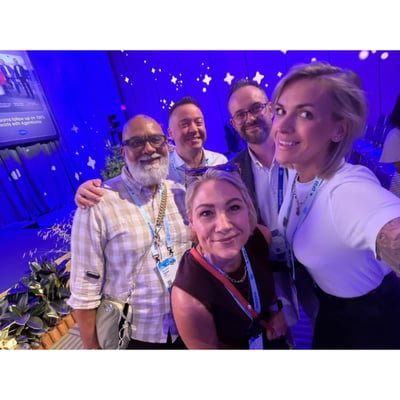
Among all the launches, demos and packed sessions, one was always going to feel a little different for us. Tom Kempster, Director of Digital Innovation for Thames Valley Police and Hampshire & Isle of Wight Constabulary, took to the stage to share how the two forces are rethinking IT service management for around 17,000 users. And yes, hearing Infomentum recognised as the delivery partner behind that work was a pretty proud moment for the team!
Faced with a tight window before their existing platform renewal, the forces worked with Infomentum to deliver an MVP on Salesforce in under ten weeks. The ambition goes beyond replacing an ITSM platform too, with Agentforce creating the potential to extend support beyond traditional service desk hours for officers who can need help at any time of day or night. Tom’s advice to the room was refreshingly practical:
"Don’t try to solve everything at once. Start with an MVP. Choose a strong knowledge base or use case. Get it into people’s hands. Learn from how they use it. Then build."
Against some of the huge visions being shared throughout the week, that was an important message to bring home. Starting small doesn’t have to mean thinking small.
If you'd like to read more about how we helped transform their IT service management with AI, check out the full case study here.
The more agents can do, the more the guardrails count
If an agent can change a record, contact a customer, access sensitive information or trigger another process, how do you decide what it should be allowed to do?
Salesforce Guardian brought areas including agent identity and data protection into focus, while MuleSoft’s Agent Fabric showed how organisations can discover and govern agents across a growing AI estate. As agents are trusted with more responsibility, deciding where they can act, when a person should step in and what happens when something doesn’t look right becomes part of designing the use case from day one.
So what are we bringing home (besides half of Sephora)?
AI agents are moving deeper into everyday work, while the way people interact with software is beginning to change. Behind both sit the data, connections, guardrails and human judgement needed to make it all work.
For us, the exciting part isn’t trying to use every new capability that appears. It’s finding the places where AI could genuinely make something work better for our customers (and our future customers!), putting the right foundations around it and learning as you go.